
ASDA George
Read More about ASDA GeorgeCircular Economy Principles
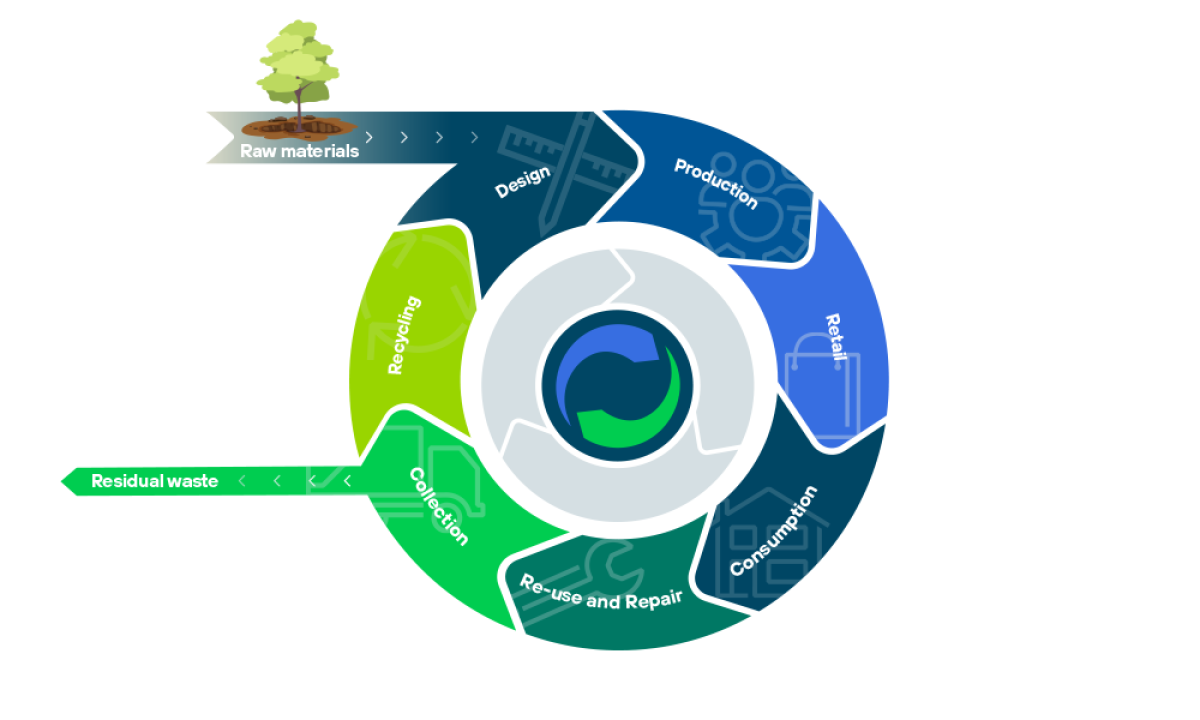
Circular economy principles are the practical rules that guide the shift away from the traditional take, make, dispose model. The Ellen MacArthur Foundation defines three: eliminate waste and pollution, circulate products and materials at their highest value, and regenerate natural systems. Together, they give businesses a framework for cutting environmental impact while creating new sources of value.
What are circular economy principles?
Circular economy principles are the foundations that separate a circular business model from a linear one. Rather than treating “take, make, dispose” as inevitable, the principles set out how materials, products and resources should move through a business so that their value is retained for as long as possible.
The principles were formalised by the Ellen MacArthur Foundation, building on decades of thinking from industrial ecology, cradle-to-cradle design, and Walter Stahel’s performance economy. For a full definition of the model itself, our circular economy overview covers how the system works end-to-end.
These aren’t abstract ideas that sit in sustainability strategies. They help shape procurement decisions, product design briefs, and the regulations businesses now have to comply with, from Extended Producer Responsibility (EPR) to reporting requirements under emerging circular economy trends. Understanding them properly is the first step businesses should take before acting on them.
The three circular economy principles
The Ellen MacArthur Foundation sets out three core principles. Businesses that embed all three, rather than picking one, see the strongest results.
Eliminate waste and pollution
The linear economy creates waste by design. Circular thinking removes it before it happens, by rethinking materials and processes at the outset rather than managing the fallout afterwards.
In practice, this means:
- Designing products and packaging to be recyclable or reusable from the start
- Reviewing material lifecycles to understand carbon and cost impact
- Building closed-loop manufacturing processes that recycle materials within production
- Using data and analytics to cut resource use and excess
This principle is especially important where material and disposal costs are high. By redesigning packaging to be lighter and easier to recycle, businesses can reduce landfill waste and lower their EPR fee liability under current UK and EU packaging regulations.

Circulate products and materials
Instead of discarding products after one use, this principle keeps them in circulation, at their highest possible value, for as long as possible.
In practice, this means:
- Designing for durability and repairability
- Supporting resale and second-hand markets
- Investing in remanufacturing to restore used products to near-new condition
- Exploring product-as-a-service models that shift ownership to access
This is where reverse logistics becomes critical. A product can only circulate if there’s a reliable system to collect, sort, and redistribute it, which is why returns management and reverse logistics infrastructure sit at the centre of most successful circulation strategies.
Regenerate natural systems
The third principle goes beyond minimising harm. It actively restores the ecosystems that a business depends on, rather than simply drawing down on them.
In practice, this means:
- Shifting to renewable energy sources
- Supporting regenerative agriculture and soil health
- Committing to deforestation-free, sustainable sourcing
- Investing in restoration projects such as reforestation
Of the three principles, this is the one most often overlooked, because its benefits are longer-term and harder to attribute directly to a single business decision. That doesn’t make it optional. Businesses with material dependence on natural systems, food, textiles, and construction materials have the most to lose from ignoring it.
These three principles sit closely alongside the waste hierarchy, which ranks prevention and reuse above recycling, with disposal treated as a last resort. For a side-by-side comparison with the model being replaced, see our guide to linear economy vs circular economy.

Why circular economy principles matter for business
The case for circular economy principles isn’t just environmental, it’s commercial. The global economy is only 6.9% circular, according to the Circularity Gap Report, meaning most materials are used once and lost, both a risk and an opportunity for businesses willing to close the gap.
Applying these principles delivers value in three ways: lower cost through reduced material use and waste, new revenue through resale, leasing and recycling, and greater resilience through less dependence on virgin materials and volatile supply chains.
There’s a regulatory angle too. Producer responsibility, deposit return schemes, and packaging regulation are circular economy principles written into law, and businesses already embedding them operationally find compliance far less disruptive.
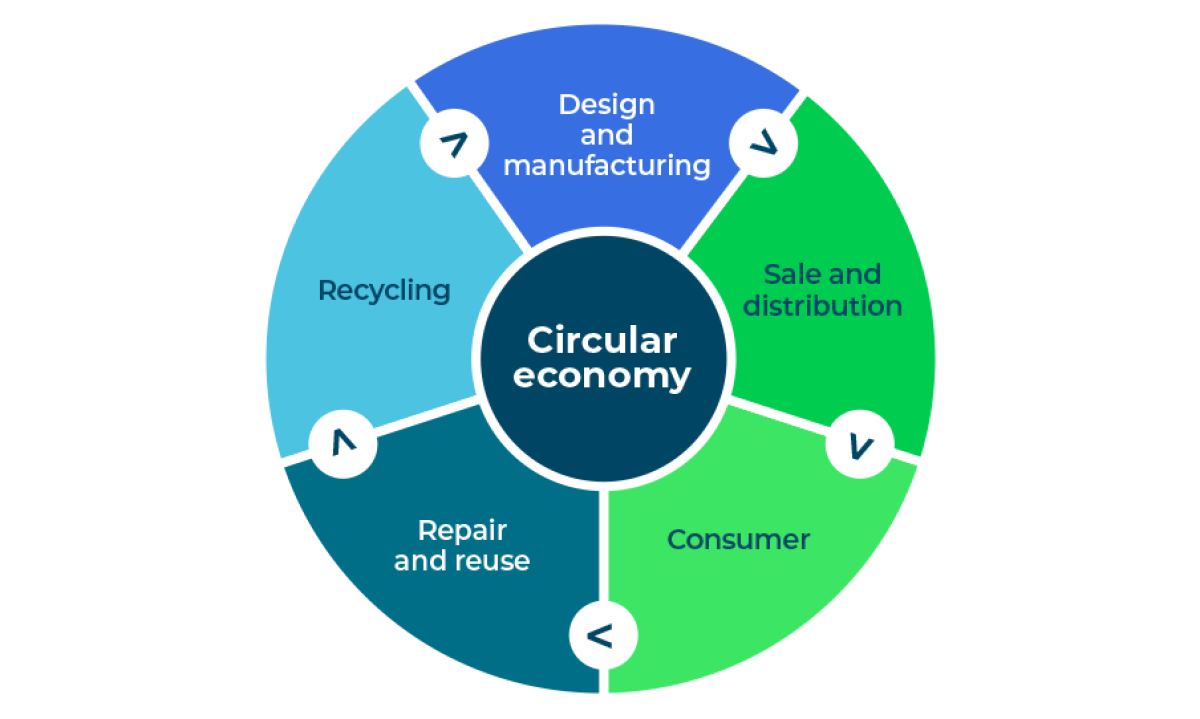
How to implement circular economy principles
Applying these principles is rarely a single project. It’s a gradual shift across key business functions like procurement, operations, and product design.
Businesses that make the most progress tend to:
- Start with a baseline audit of current material flows and waste streams
- Prioritise the areas with the clearest financial case first, such as packaging or high-volume waste streams
- Build supplier and partner relationships that support take-back, reuse or recycling
- Track progress against clear circularity metrics, not just cost savings
Sequencing matters here. Businesses that try to apply all three principles everywhere at once tend to lose momentum. Starting with one or two high-impact areas, proving the commercial case, and then scaling tends to produce more durable change than a single, all-encompassing programme.
Download our 10-point framework
Reconomy’s 10-Point Framework to enable the Circular Economy
To support systemic change, Reconomy has developed a 10-point regulatory framework. These principles are designed to simplify waste systems, drive investment, and scale up sustainable practices.

Common mistakes when applying circular economy principles
A few patterns show up repeatedly in businesses that struggle to make progress:
- Treating recycling as the whole strategy. Recycling sits at the middle of the waste hierarchy. Businesses that focus exclusively on it, without addressing design or reuse, tend to see diminishing returns.
- Applying principles in isolation. A business that redesigns packaging but leaves its reverse logistics unchanged will still lose materials at the collection stage.
- Underestimating supplier dependency. Circular outcomes usually depend on suppliers being willing and able to take materials back, which requires early engagement, not a late-stage request.
- No baseline data. Without a clear picture of current material and waste flows, it’s difficult to prove progress or prioritise effectively.
None are difficult to avoid once identified, but they’re easy to fall into without external guidance or following a structured framework.

How to measure progress against circular economy principles
Applying circular economy principles is only useful if progress can be measured. Common approaches include:
- Circularity indicators, such as the Material Circularity Indicator (MCI), which measure how much of a product or material stays in circulation.
- Waste diversion and recycling rates, tracking the percentage of material kept out of landfill.
- Carbon footprint reduction, assessing emissions saved through circular practices compared with a linear baseline.
Without measurement, it’s difficult to distinguish genuine circular progress from activity that looks circular but doesn’t move the needle commercially or environmentally.
Circular economy principles in construction and other sectors
The Carbon Border Adjustment Mechanism is the EU’s tool for putting a carbon price on imported goods, so that imports carry a cost similar to the one EU producers already pay under the EU Emissions Trading System (ETS).
Its purpose is to prevent carbon leakage. Carbon leakage happens when production moves to countries with weaker climate rules, or when EU goods are undercut by cheaper, higher-emission imports. By pricing the emissions embedded in covered imports, CBAM is designed to level the playing field while encouraging cleaner production worldwide.
In short, CBAM turns the carbon emitted in making a product into a regulated cost at the EU border, rather than a voluntary sustainability metric.
Construction
In construction, they show up as modular design, on-site material recovery, and the use of recycled aggregates in place of virgin material. Building design increasingly factors in disassembly from the outset so that materials can be recovered at end of life rather than demolished into mixed waste.
Explore circularity in constructionRetail and grocery
In retail and grocery, they show up as closed-loop packaging, reduced food waste, and supply chains designed around reusable transit packaging rather than single-use formats.
Understand circularity in grocery retailFashion and textiles
In fashion and textiles, they show up as repair, resale and take-back schemes, alongside emerging Extended Producer Responsibility requirements that are pushing brands to design garments for longer life and easier recycling.
Learn about circular fashionAutomotive
In automotive, they show up as leasing models, remanufacturing of components, and reverse logistics systems that keep parts and materials in productive use rather than scrapping them after a single lifecycle.
Discuss circularity in automotive
Putting circular economy principles into practice with Reconomy
Understanding the three principles is the starting point. Applying them across procurement, operations, compliance and reverse logistics is where the commercial value sits.
Reconomy’s specialist brands support this, from environmental compliance and producer responsibility through to material recovery and reverse logistics. Whether you’re at the audit stage or scaling an existing circular programme, our teams work across each of these areas so the three principles translate into a workable operational plan, not just a strategy document.
If you’re ready to embed circular economy principles into how your business operates, speak to our team.
Speak to our circularity expertsRelated regulations and resources
PPWR does not sit in isolation. It connects to a wider set of packaging and circular economy regulations, and this hub links to the content that helps you navigate them:
Latest news
Download our 2025 Sustainability Report
This report shares our latest progress towards sustainability targets and our updated sustainability strategy, Action: 2030.
FAQs
The Ellen MacArthur Foundation’s three circular economy principles are: eliminate waste and pollution, circulate products and materials at their highest value, and regenerate natural systems.
The Ellen MacArthur Foundation’s original framework sets out three principles. Some frameworks add a fourth, such as “design out waste” as a standalone step, but this is generally treated as part of the first principle rather than a separate one.
Reduce, reuse, recycle is a household-level waste hierarchy. Circular economy principles are a broader business framework covering product design, material flows and ecosystem regeneration, of which reduce, reuse and recycle form only one part.
Most businesses start with an audit of current material and waste flows, then prioritise the changes with the clearest financial case, such as packaging redesign or high-volume waste streams, before scaling to supplier relationships and product design.
Circular economy principles increasingly sit behind regulation such as Extended Producer Responsibility (EPR), which holds businesses accountable for the full lifecycle of the products and packaging they place on the market.
Common measures include circularity indicators such as the Material Circularity Indicator, waste diversion and recycling rates, and carbon footprint reduction. Reconomy’s Zero Waste Index is one practical tool businesses use to track this.
Speak to our circularity experts