
Commercial Food Waste Disposal and Collection
Commercial food waste disposal is the separate collection, storage and recycling of food waste from business premises. Reconomy provides food waste bins, scheduled and one-off collections, and on-site treatment equipment across the UK, with food waste sent to anaerobic digestion or composting rather
Speak to our teamCommercial food waste collection and management services
Our food waste service keeps organic waste separate, hygienic and compliant from the kitchen to the treatment facility. Whether you run a single café or a national estate, we tailor containers, collection frequency and reporting to the way your sites operate, so you deal with one supplier instead of several. Food waste can sit alongside your general waste collection and dry mixed recycling under the same account.
Scheduled food waste collections
Scheduled collections suit businesses with steady, predictable volumes, such as restaurants, hotels, schools, hospitals and food manufacturers. Collection planning starts with how much food waste you produce each week, how much storage space you have and how quickly waste needs to leave site to stay hygienic.
One-off and peak-period food waste removal
One-off removals cover seasonal peaks, events, refits, site closures and unexpected surpluses. They let you handle a temporary rise in food waste without committing to a permanent schedule.
Compliance, reporting and duty of care
Every collection is carried out by authorised waste carriers and backed by the waste transfer information you need to meet your duty of care. Our waste data management and Zero Waste Index tools turn collection records into clear reporting for environmental compliance, landfill diversion and sustainability targets.
Food waste bins and containers
The right container depends on your waste volumes, site layout, storage space and preferred collection frequency. Most businesses pair small internal caddies in kitchens and preparation areas with secure, lidded external bins for storage between collections. Good container planning keeps food waste separate, limits odours and pests, and makes collections easier for your team. Browse our full range of [commercial wheelie bins](https://www.reconomy.com/what-we-do/recycle/waste-management/on-demand-waste-services-for-smes/wheelie-bins/) .
120 litre wheelie bin
A compact option for smaller kitchens, cafés and offices with low to moderate volumes of food waste, or sites with limited outdoor space.
240 litre wheelie bin
The most common food waste bin for busy kitchens and hospitality venues. View 240 litre wheelie bin dimensions and details.
Front end loader bins
Larger front end loader bins suit high-volume producers such as food manufacturers, large retail sites and shopping centres.
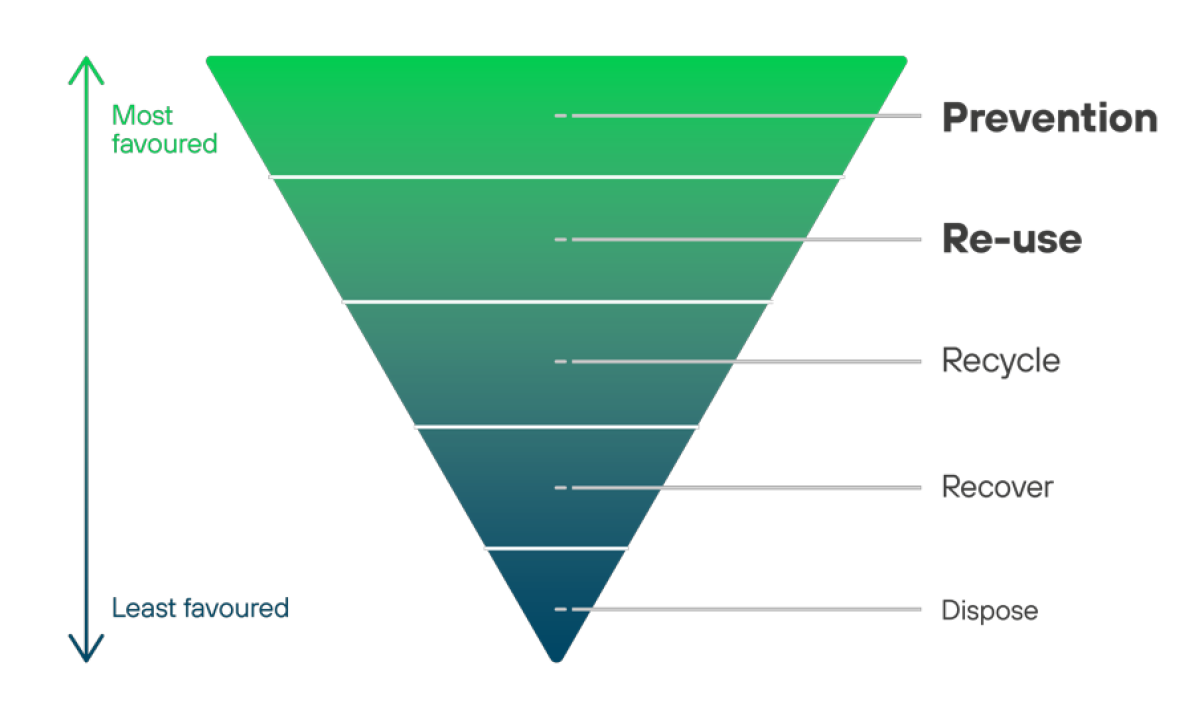
The waste hierarchy and food waste recycling
The waste hierarchy ranks options for managing waste by their environmental impact. For food, the priority order is:
- Prevent: track what you throw away, improve demand planning and menu planning, and store food correctly so less is wasted in the first place.
- Redistribute: donate surplus food that is still safe to eat to charities and redistribution networks.
- Feed animals where permitted: some surplus from food manufacturing can become animal feed if it meets strict rules. Catering and kitchen waste cannot be fed to farmed animals in the UK.
- Recycle: send unavoidable food waste to anaerobic digestion or composting.
- Recover: use other energy recovery routes where recycling is not possible.
- Dispose: landfill is the last resort and should be avoided for food waste.
Separate food waste collections sit at the recycling stage. They give unavoidable waste a second life and keep it out of general waste, where it adds weight, cost and contamination. Poorly managed food waste also creates risks on site, as explained in our guide to food safety hazards that result from poor waste management.
How commercial food waste recycling works
Food waste is collected from your premises, checked for contamination and taken to a licensed treatment facility. There it is de-packaged where needed and processed through anaerobic digestion or composting, producing renewable energy, biofertiliser, compost or soil improvers. This keeps food in a circular economy and recovers value that landfill would lose.
Get a food recycling quoteOn-site food waste management solutions
As well as bins and collections, we supply on-site equipment that reduces the space, weight and collection costs of food waste. Explore our wider range of recycling equipment, including waste compactors for dry waste streams.
Food waste dryers
Automated, heavy-duty dryers use high temperatures to remove moisture from catering and packaged food waste, leaving an inert, sanitised and odourless output that can be used as biomass for renewable energy.
- Reduces the weight and volume of food waste by up to 90%
- Biomass output can support on-site renewable energy generation
- Sizes available to process from 50kg to 200 tonnes per day
- Batch processing times of 5 to 7 hours
- Minimises food waste storage requirements

Food waste dewaterers
Dewaterers separate liquid from food waste, leaving drier solids that are cheaper to store, collect and send for recycling.
- Processes up to 700kg of waste per hour
- Reduces the volume of waste by up to 80% and the weight by up to 50%
- Recovers over 90% of solids
- Self-cleaning mechanism to reduce blockages
- Can be retrofitted to existing food waste collection and disposal systems
Food waste composters
In-vessel composters turn food and garden waste from catering and food services into compost in 14 days. A continual flow system produces compost daily as more waste is added, and leak-resistant seals come as standard to prevent seepage and deter vermin.
- Robust, reliable and easy to use
- Capacities to process between 300 and 10,500 litres of organic waste per week
- Fewer collection vehicle visits and lower transport costs
- Needs a single-phase power supply and a covered area for simple set-up

Food grade IBCs, pallets and Dolavs
For food and drink businesses, we supply food grade storage and handling equipment that protects hygiene across your supply chain.
- Food grade IBCs: robust intermediate bulk containers, most commonly 1,000 litres, that are easy to clean and compatible with standard handling equipment.
- Food grade pallets: resistant to moisture and bacterial growth, easy to sanitise and built for durability. We also offer pallet collection for end-of-life pallets.
- Dolavs: large rigid containers that improve waste segregation, reduce contamination, enhance workplace safety and streamline recycling.
We design food waste strategies for organisations across many sectors, including:
- Restaurants, cafés, pubs and hotels: high, steady volumes of preparation and plate waste.
- Food wholesale and distribution: see how we partner with Brakes on recycling management.
- Shopping centres and retail: see our Manchester Arndale case study on improving recycling rates.
- Care homes and healthcare: see our work with Sunrise Senior Living UK.
- Office canteens and kitchens: alongside our office recycling services.
- Construction sites: temporary canteens and welfare units as part of wider construction waste management.
- Multi-site organisations: a single point of contact through our national account managed waste services.
Anaerobic digestion is the main recycling route for commercial food waste in the UK, and it is especially well suited to wet, mixed food waste from kitchens and food production.
How anaerobic digestion works
Microorganisms break down food waste in sealed tanks without oxygen. The process produces biogas, which is used to generate electricity, heat or biomethane for the gas grid, and digestate, a nutrient-rich material that farmers use as a biofertiliser.
Benefits of anaerobic digestion
- Renewable energy: biogas from your food waste displaces fossil fuel energy.
- Lower emissions: food rotting in landfill releases methane, a powerful greenhouse gas. Anaerobic digestion captures that gas and puts it to use.
- Nutrients back to the soil: digestate returns nitrogen, phosphorus and potassium to farmland, reducing the need for manufactured fertilisers.
- Cost control: separating food waste reduces the weight of your general waste, which typically costs more to dispose of.
- Better reporting: food waste recycled through anaerobic digestion counts towards landfill diversion and supports your carbon and ESG reporting.
Anaerobic digestion vs composting
Composting uses oxygen to break down organic waste into compost. It works well for garden waste and some food scraps, while anaerobic digestion is usually preferred for wet food waste because it also generates energy. Both routes divert organic waste from landfill. If you also handle packaging labelled as compostable, our guide to biodegradable vs compostable vs bio-based materials explains what can go where.
Food waste regulations in the UK
Food waste rules differ across the UK, so planning your collections around the regulations for each site is essential.
England: Simpler Recycling
Since 31 March 2025, workplaces in England with 10 or more full-time equivalent employees must separate food waste from other waste for collection. There is no minimum weight threshold, so the duty applies regardless of how much food waste you produce. Micro-firms with fewer than 10 full-time equivalent employees must comply from 31 March 2027. Read more about Simpler Recycling for businesses and the Simpler Recycling rules and timeline.
Understand Simpler RecyclingWales: Workplace Recycling
In Wales, workplaces that produce more than 5kg of food waste in a week must present it separately for collection. Our guide for Welsh businesses explains the requirements.
Request guidanceScotland and Northern Ireland
Scotland and Northern Ireland have their own food waste regulations. If you operate across the UK, check the rules that apply to each location and your local authority guidance for further information.
Speak to our expertsRelated services
Explore our related services for commercial waste management and disposal
Request a quote
Commercial food waste management FAQs
A typical service includes dedicated food waste bins, collection of prepared and unprepared food waste (fruit and vegetable scraps, meat, fish, dairy and bakery products), regular or customised collection schedules, and transport to an approved anaerobic digestion or composting facility. Some services also accept food-contaminated packaging. You should also receive the documentation, waste data and information needed for environmental compliance.
Choose scheduled removal if you produce food waste regularly and in predictable volumes. Choose one-off removal for occasional clearances, events, seasonal peaks or site closures. Many businesses use both.
Most businesses need internal caddies for kitchens and preparation areas, plus secure external containers for storage between collections. We offer 120 litre and 240 litre wheelie bins and front end loader bins, sized to your volumes and collection frequency.
Both. Anaerobic digestion is usually preferred for wet commercial food waste because it produces renewable energy as well as biofertiliser. Composting is commonly used for garden waste and some food scraps.
In England, all workplaces with 10 or more full-time equivalent employees have had to separate food waste since 31 March 2025, with no minimum weight threshold. This includes retailers, hospitality businesses, offices, schools, hospitals, care homes and manufacturers. Micro-firms must comply from 31 March 2027. Wales, Scotland and Northern Ireland have separate rules.
Compare total cost, collection frequency, container options, the recycling route used, compliance support, reporting, service reliability and environmental outcomes. The best provider will help you reduce waste as well as collect it.
Start with the waste hierarchy: forecast demand accurately, optimise stock levels, store food correctly, train staff and track waste regularly. Donate safe surplus food and recycle what is left through anaerobic digestion or composting. Our overview of the circular economy in the grocery industry shows how retailers are closing the loop.