
ASDA George
Read More about ASDA GeorgeDigital product passport for textiles: what's required and how to prepare
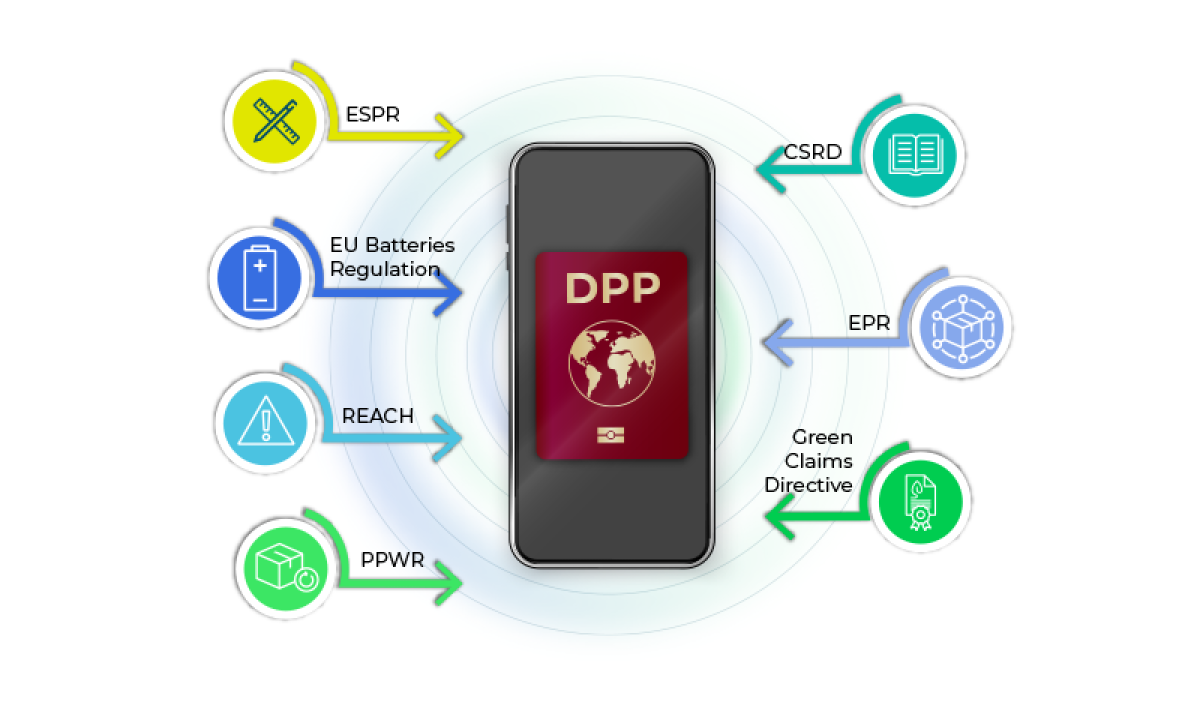
A digital product passport for textiles is a digital record, accessible via a QR code or similar data carrier, that stores standardised information about a garment or textile product: its materials, origin, durability, repairability and environmental impact. Textiles are a priority sector under the EU’s Ecodesign for Sustainable Products Regulation, with mandatory rollout expected from 2028 onwards.
What is a digital product passport for textiles?
A digital product passport (DPP) for textiles is a structured digital record attached to a garment, accessory or textile product, usually accessed via a QR code or similar data carrier sewn or printed onto the item. It holds standardised information about that product’s materials, manufacturing, durability, repairability and environmental impact, which will be made available to consumers, retailers, recyclers and regulators. The data will be gated based on role, so consumers only get access to consumer-centric data..
DPPs are being introduced under the EU’s Ecodesign for Sustainable Products Regulation (ESPR), which entered into force in July 2024. ESPR sets the overarching framework for DPPs across many product categories. The specific data requirements for each sector, including textiles, are set out separately in product-specific delegated acts, which is why “DPP for textiles” needs its own explanation distinct from the general DPP framework.
Why textiles are a DPP priority sector
Textiles sit near the top of the EU’s list of priority sectors for DPP rollout, alongside batteries, electronics, furniture and construction products. The European Commission’s ESPR Working Plan 2025 to 2030, adopted in April 2025, formally named textiles and apparel as one of the first product groups to receive dedicated ecodesign and DPP requirements.
The reasoning is straightforward. Textiles create a disproportionate environmental footprint compared to other consumer product categories, driven in large part by fast fashion’s short product lifespans and low repair and reuse rates. Regulators see standardised, verifiable product data as a precondition for tackling that, both to hold producers accountable and to give consumers, resellers and recyclers reliable information to act on.
When will DPP be mandatory for textiles?
There’s no single DPP deadline. Each product category gets its own delegated act and compliance date. Batteries are first, with mandatory passports from February 2027, and that rollout is widely treated as the technical template the textiles requirements will follow.
For textiles specifically, the picture as it stands is:
- The delegated act setting out textile-specific DPP requirements is expected to be adopted around 2027, though the exact date has moved before and may move again.
- Once adopted, businesses are typically given a minimum transition period, commonly cited as around 18 months, before compliance becomes mandatory.
- On that basis, realistic mandatory compliance for textiles sits at 2028 at the earliest, and some industry analysts expect it to land closer to late 2028 or 2029 given the pattern of delay seen elsewhere in the ESPR rollout.
Given how much this timeline has already shifted, businesses selling textiles into the EU are better served preparing for the direction of travel than waiting for a final date to be confirmed.
Download our 10-point framework
Reconomy’s 10-Point Framework to enable the Circular Economy
To support systemic change, Reconomy has developed a 10-point regulatory framework. These principles are designed to simplify waste systems, drive investment, and scale up sustainable practices.
How DPP connects to textile EPR
Digital product passports and textile Extended Producer Responsibility (EPR) are separate pieces of regulation, but they’re built to work together. EPR makes producers financially and organisationally responsible for what happens to a textile product at end of life. DPPs provide the underlying product data that makes EPR reporting, eco-modulated fees and end-of-life routing possible in practice.
Several EU member states are already building national textile EPR schemes independently of the EU-wide DPP timeline. France’s Refashion scheme has been running for several years, the Netherlands already has textile EPR rules in place, and countries including Spain and Italy are progressing their own draft decrees. Businesses operating across multiple EU markets are, in effect, managing two related but distinct compliance tracks at once: national EPR obligations that are landing now, and EU-wide DPP obligations that are still being finalised.
Our guide to textile EPR across Europe covers how these national schemes compare.
Explore EPR for textilesHow to prepare your business
Businesses don't need a finalised delegated act to start preparing. The most useful early steps are:
Map your product data
Understand what material, sourcing and manufacturing data you already hold, and where the gaps sit across your supply chain.
Engage your supply chain early
Much of the data a textile DPP will require sits with suppliers, not with the brand itself, so early supplier engagement avoids a scramble later.
Choose the right infrastructure
Passport-ready data needs a system that can standardise and hold it, rather than scattered spreadsheets across different teams and suppliers.
Track textile EPR obligations in parallel
Since DPP and EPR data overlap significantly, addressing them together avoids duplicated effort.

How Reconomy's specialist brands can help
Reconomy’s specialist Comply Loop brands focus on textile producer responsibility, helping businesses navigate both textile EPR and the incoming DPP requirements as a connected compliance track, not two separate projects.
Reconomy’s partnerships with Fabacus and Buyerdock give businesses access to established DPP technology, covering supply chain mapping, traceability and QR code integration, delivered through our Comply Loop alongside our existing EPR services for textiles. Rather than treating DPP as a standalone IT project, we connect it to the data your business already needs for EPR reporting, reducing duplicated work across compliance teams.
If your business needs support assessing its exposure to DPP for textiles, speak to our textiles compliance team.
Speak to our expertsFAQs
A digital product passport for textiles is a digital record, usually accessed via a QR code, that holds standardised data on a textile product’s materials, manufacturing, durability, repairability and environmental impact, required under the EU’s Ecodesign for Sustainable Products Regulation.
The delegated act setting textile-specific DPP requirements is expected around 2027, with a transition period of roughly 18 months after adoption. Realistic mandatory compliance is 2028 at the earliest, with some analysts expecting further slippage into 2029.
Yes. Any business placing textile products on the EU market is expected to fall within scope, regardless of where the business is based, in the same way EU EPR and ESPR obligations already apply to non-EU sellers.
A digital product passport provides standardised product data. Textile EPR is a separate regulatory framework that makes producers financially responsible for a product’s end-of-life management. The two are designed to work together, since EPR reporting and eco-modulated fees depend on the kind of data a DPP holds.
Based on the ESPR framework and the precedent set by the battery passport, a textile DPP is expected to cover material composition and origin, manufacturing information, durability and repairability, recyclability, environmental impact data, and supply chain traceability.
Most businesses start by mapping what product and supply chain data they already hold, identifying gaps, and engaging suppliers early, since much of the required data sits outside the brand’s own systems.
Speak to our DPP experts to comply
Related guidance
Explore more expert guidance from Reconomy surrounding legislaton and the Circular Economy.